68 NiuNiu Card Type Quick Reference
The 68 NiuNiu card type quick reference helps you quickly understand which special card type a red envelope amount corresponds to, its rank, and its multiplier. The six card types, from highest to lowest, are 豹子 (Baozi), 满牛 (Manniu), 反顺 (Fanshun), 顺子 (Shunzi), 对子 (Duizi) and 金牛 (Jinniu), corresponding to multipliers from 18x down to 11x. When comparing results, the card type is checked first — whichever side has the higher card type wins, and the red envelope amount itself is never used as the basis for judgment. When neither side has a special card type, the corresponding points are compared instead.
- 1. 68 NiuNiu Card Type Size and Multiplier Quick Reference
- 2. Baozi (豹子): All Three Digits Are the Same
- 3. Manniu (满牛): The Red Envelope Amount Is a Whole Number
- 4. Fanshun and Shunzi (反顺与顺子): Consecutive-Number Card Types
- 5. Duizi and Jinniu (对子与金牛): Matching Digits and a First/Last Digit of 0
- 6. How Card Types and Points Are Compared
- 7. 68 NiuNiu Card Type FAQ
68 NiuNiu Card Type Size and Multiplier Quick Reference
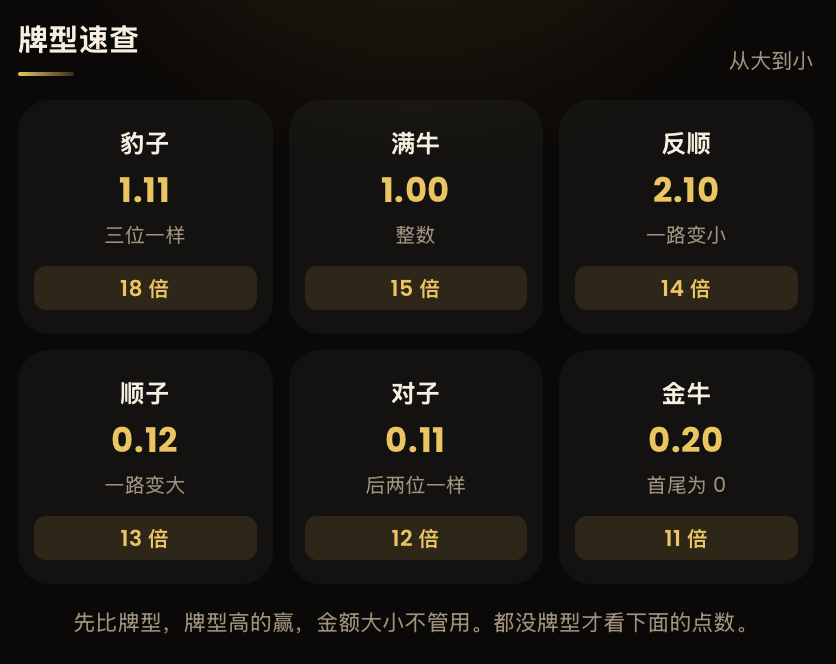
68 NiuNiu card types are compared in a fixed order, from highest to lowest: 豹子 (Baozi), 满牛 (Manniu), 反顺 (Fanshun), 顺子 (Shunzi), 对子 (Duizi) and 金牛 (Jinniu). The six card types correspond to 18x, 15x, 14x, 13x, 12x and 11x respectively. When judging the result of a round, first confirm whether either side has formed a special card type, then compare according to the card type order.
No. 1: 豹子 (Baozi) | 18x
豹子 (Baozi) is the highest special card type in this quick reference. It is formed when all three digits of the red envelope amount are the same. The example shown is 1.11, which corresponds to 18x.
No. 2: 满牛 (Manniu) | 15x
满牛 (Manniu) ranks just below 豹子 (Baozi). It is formed when the red envelope amount is a whole number. The example shown is 1.00, which corresponds to 15x.
No. 3: 反顺 (Fanshun) | 14x
反顺 (Fanshun) is a special card type formed by consecutive digits, characterized by the digits decreasing in sequence. The example shown is 2.10, which corresponds to 14x.
No. 4: 顺子 (Shunzi) | 13x
顺子 (Shunzi) runs in the opposite direction to 反顺 (Fanshun), characterized by the digits increasing in sequence. The example shown is 0.12, which corresponds to 13x.
No. 5: 对子 (Duizi) | 12x
对子 (Duizi) is judged by whether the last two digits of the red envelope amount are the same. The example shown is 0.11, which corresponds to 12x.
No. 6: 金牛 (Jinniu) | 11x
金牛 (Jinniu) is characterized by the first and last digits of the red envelope amount both being 0. The example shown is 0.20, which corresponds to 11x.
| Card Type | Points / Feature | Multiplier |
|---|---|---|
| 豹子 (Baozi) | 1.11|all three digits match | 18x |
| 满牛 (Manniu) | 1.00|whole number | 15x |
| 反顺 (Fanshun) | 2.10|decreasing sequence | 14x |
| 顺子 (Shunzi) | 0.12|increasing sequence | 13x |
| 对子 (Duizi) | 0.11|last two digits match | 12x |
| 金牛 (Jinniu) | 0.20|first and last digit are 0 | 11x |
豹子 (Baozi): All Three Digits Are the Same
豹子 (Baozi) ranks highest among the current 68 NiuNiu special card types. It is formed whenever all three digits used for judgment in the red envelope amount are identical.
豹子 (Baozi) Example: 1.11
Take 1.11 on the page as an example — all three digits used for judgment are 1, forming 豹子 (Baozi).
豹子 (Baozi) Corresponds to 18x
豹子 (Baozi) carries a multiplier of 18x, the highest among the six card types in this quick reference, and it also ranks first in card type order.
满牛 (Manniu): The Red Envelope Amount Is a Whole Number
满牛 (Manniu) ranks just below 豹子 (Baozi) in the card type order. This quick reference uses a "whole number" as the defining feature of 满牛 (Manniu), shown here with 1.00 as the example.
满牛 (Manniu) Example: 1.00
The page uses 1.00 as the 满牛 (Manniu) example. Under the current rules, this type of whole-number red envelope amount corresponds to 满牛 (Manniu).
满牛 (Manniu) Corresponds to 15x
满牛 (Manniu) corresponds to 15x — lower than 豹子 (Baozi) at 18x, but higher than 反顺 (Fanshun), 顺子 (Shunzi), 对子 (Duizi) and 金牛 (Jinniu).
反顺与顺子 (Fanshun and Shunzi): Consecutive-Number Card Types
反顺 (Fanshun) and 顺子 (Shunzi) are both based on consecutive digits, with the main difference being the direction of the sequence. 反顺 (Fanshun) decreases in sequence, while 顺子 (Shunzi) increases in sequence; the two also differ in card type order and multiplier.
反顺 (Fanshun): 2.10|14x
The 反顺 (Fanshun) example is 2.10 — the digits decrease in sequence as 2, 1, 0, forming 反顺 (Fanshun), which corresponds to 14x.
顺子 (Shunzi): 0.12|13x
The 顺子 (Shunzi) example is 0.12 — the digits increase in sequence as 0, 1, 2, forming 顺子 (Shunzi), which corresponds to 13x.
反顺 (Fanshun) Ranks Higher Than 顺子 (Shunzi)
In the current card type order from highest to lowest, 反顺 (Fanshun) ranks above 顺子 (Shunzi). So when one side forms 反顺 (Fanshun) and the other forms 顺子 (Shunzi), the result is judged by card type order first.
对子与金牛 (Duizi and Jinniu): Matching Digits and a First/Last Digit of 0
对子 (Duizi) and 金牛 (Jinniu) are judged by different digit combinations. 对子 (Duizi) looks at whether the last two digits of the red envelope amount match, while 金牛 (Jinniu) checks whether the first and last digits are both 0.
对子 (Duizi): 0.11|12x
The page example for 对子 (Duizi) is 0.11, where the last two digits are both 1, meeting the "last two digits match" condition and corresponding to 12x.
金牛 (Jinniu): 0.20|11x
The 金牛 (Jinniu) example is 0.20, where the first and last digits are both 0, meeting the "first and last digit are 0" condition and corresponding to 11x.
对子 (Duizi) Ranks Higher Than 金牛 (Jinniu)
Among the six special card types, 对子 (Duizi) ranks above 金牛 (Jinniu), so 对子 (Duizi) outranks 金牛 (Jinniu); their corresponding multipliers are 12x and 11x respectively.
How Card Types and Points Are Compared
68 NiuNiu checks the card type first when judging a result. Whenever a special card type is formed, it takes priority over the red envelope amount, which is never used as the basis for judging a special card type. Only when neither side has a special card type does the comparison move on to points.
Step One: Check for a Special Card Type First
Based on the red envelope result, check whether it meets the conditions for 豹子 (Baozi), 满牛 (Manniu), 反顺 (Fanshun), 顺子 (Shunzi), 对子 (Duizi) or 金牛 (Jinniu). If one of these card types is formed, it should be handled according to the card type rules first.
Step Two: Compare Card Type First When One Is Formed
When both sides have special card types, compare them in order from highest to lowest: 豹子 (Baozi), 满牛 (Manniu), 反顺 (Fanshun), 顺子 (Shunzi), 对子 (Duizi), 金牛 (Jinniu). The side with the higher card type has the advantage.
Step Three: The Red Envelope Amount Doesn't Decide It
Comparing special card types is not a direct comparison of who grabbed more RM. For example, when a higher card type is formed from the amount, the card type order is used as the basis for judgment — the result is never decided simply by the size of the red envelope amount.
Step Four: Only Compare Points When Neither Side Has a Card Type
If neither side has formed one of the special card types above, the comparison moves on to points. Points are calculated by adding up the digits of the red envelope amount and taking the ones digit, with a ones digit of 0 treated as the highest, 10-point Niu Niu.
68 NiuNiu Card Type FAQ
68 NiuNiu What Are the Special Card Types?
This quick reference lists six special card types: 豹子 (Baozi), 满牛 (Manniu), 反顺 (Fanshun), 顺子 (Shunzi), 对子 (Duizi) and 金牛 (Jinniu).
68 NiuNiu Which Card Type Is the Highest?
In the current order from highest to lowest, 豹子 (Baozi) ranks first, corresponding to 18x — the highest of the six special card types.
How Is 豹子 (Baozi) Judged?
豹子 (Baozi) is judged by all three digits being the same, as in the page example 1.11.
What's the Difference Between 顺子 (Shunzi) and 反顺 (Fanshun)?
The main difference is the direction of the digit sequence. 反顺 (Fanshun) decreases in sequence, e.g. 2.10; 顺子 (Shunzi) increases in sequence, e.g. 0.12. 反顺 (Fanshun) corresponds to 14x and 顺子 (Shunzi) corresponds to 13x.
How Is 对子 (Duizi) Judged?
对子 (Duizi) requires the last two digits to match, as in 0.11 where the final two digits are both 1, corresponding to 12x.
How Is 金牛 (Jinniu) Judged?
金牛 (Jinniu) is characterized by the first and last digits being 0, as in 0.20, corresponding to 11x.
When Comparing, Do You Look at Points or Card Type First?
Card type first. When a special card type is formed, it is compared by card type order first; only when neither side has a special card type are the points below compared.
Does a Bigger Red Envelope Amount Always Win?
Not necessarily. The current rules clearly state that card type is compared first, and the side with the higher card type wins — the amount itself is never used to decide between special card types. When there is no card type, points are compared instead.
Master 68 NiuNiu Card Types
Check the judging method, card type order and corresponding multiplier for 豹子 (Baozi), 满牛 (Manniu), 反顺 (Fanshun), 顺子 (Shunzi), 对子 (Duizi) and 金牛 (Jinniu), and combine them with the points rules to understand the complete comparison method.