68 NiuNiu How Many Points Equals How Many Times
The 68 NiuNiu points-to-multiplier rule is mainly used to judge ordinary cards when neither side has a special card type. Under the current rules, 1 point through 10 points correspond directly to a 1x through 10x multiplier — in other words, the points and the multiplier are the same number: 10-point Niu Niu is 10x, 9 points is 9x, all the way down to 1 point at 1x. When both sides have ordinary cards, points are compared directly, and the side with the higher points wins.
- 1. 68 NiuNiu How Many Points Equals How Many Times Rules
- 2. Multipliers from 10-Point Niu Niu to 8 Points
- 3. Multipliers from 7 Points to 5 Points
- 4. Multipliers from 4 Points to 1 Point
- 5. How Ordinary Cards Are Compared
- 6. The Difference Between Ordinary Card Multipliers and Special Card Types
- 7. 68 NiuNiu Points and Multiplier FAQ
68 NiuNiu How Many Points Equals How Many Times Rules
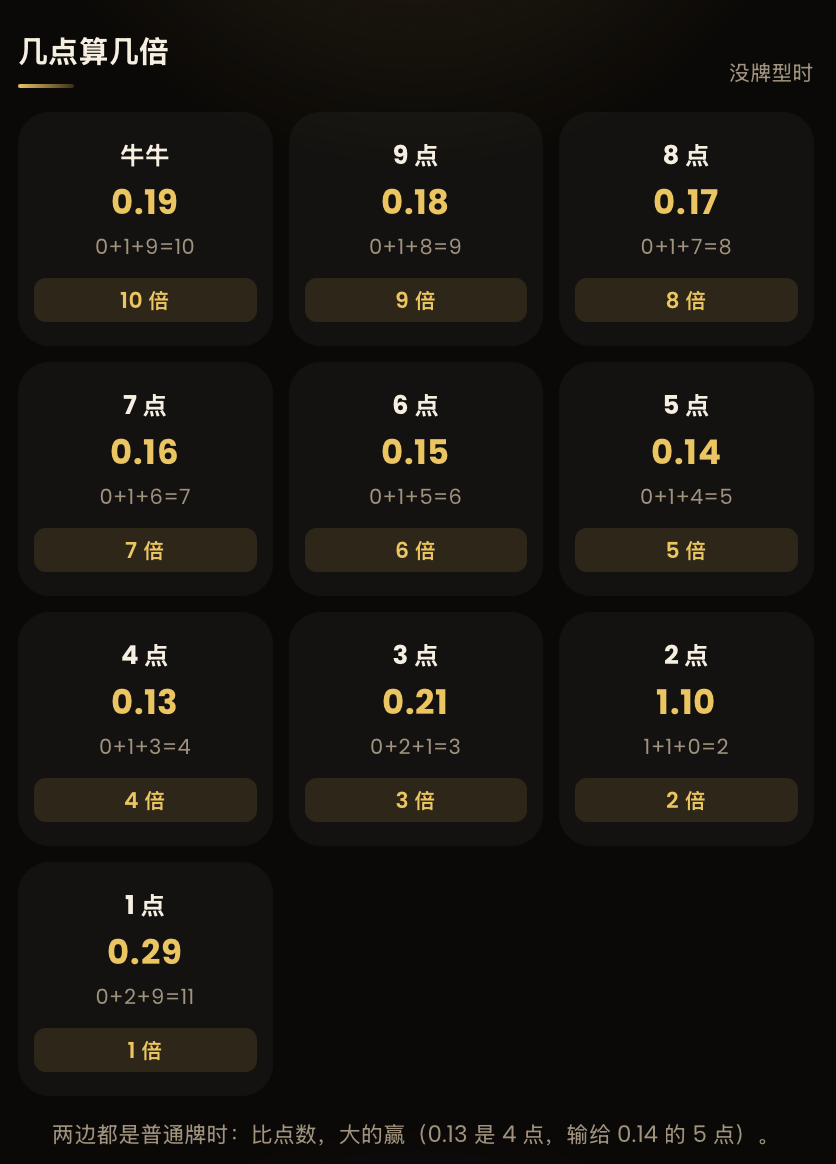
68 NiuNiu determines the multiplier from ordinary points whenever no special card type — 豹子 (Baozi), 满牛 (Manniu), 反顺 (Fanshun), 顺子 (Shunzi), 对子 (Duizi) or 金牛 (Jinniu) — is formed. The rule can be remembered simply as "however many points, that many times": 10 points is 10x, 9 points is 9x, and so on down to 1 point at 1x.
10-Point Niu Niu: 10x
10 points, also called Niu Niu, is the highest ordinary result and corresponds to 10x. The example shown is 0.19, calculated as 0 + 1 + 9 = 10, giving 10-point Niu Niu at 10x.
9 Points to 1 Point: Points Correspond Directly to the Multiplier
Apart from 10-point Niu Niu, every other ordinary card also follows the same direct points-to-multiplier correspondence. 9 points is 9x, 8 points is 8x, and so on down to 1 point at 1x.
Multipliers from 10-Point Niu Niu to 8 Points
The higher points among ordinary cards are 10-point Niu Niu, 9 points and 8 points, corresponding to 10x, 9x and 8x respectively. Points are still judged by adding up the digits of the red envelope amount and taking the ones digit, with a ones digit of 0 counted as 10-point Niu Niu.
10-Point Niu Niu: 0.19|10x
The example 0.19 is calculated as 0 + 1 + 9 = 10, so it is 10-point Niu Niu, corresponding to 10x.
9 Points: 0.18|9x
The example 0.18 is calculated as 0 + 1 + 8 = 9, so it is 9 points, corresponding to 9x.
8 Points: 0.17|8x
The example 0.17 is calculated as 0 + 1 + 7 = 8, so it is 8 points, corresponding to 8x.
Multipliers from 7 Points to 5 Points
7 points, 6 points and 5 points continue to follow the "however many points, that many times" rule, corresponding to 7x, 6x and 5x respectively. Before judging, it is still necessary to confirm that the red envelope result has not formed a higher-priority special card type.
7 Points: 0.16|7x
The digits in 0.16 add up to 0 + 1 + 6 = 7, so it is calculated as 7 points, corresponding to 7x.
6 Points: 0.15|6x
The digits in 0.15 add up to 0 + 1 + 5 = 6, so it is calculated as 6 points, corresponding to 6x.
5 Points: 0.14|5x
The digits in 0.14 add up to 0 + 1 + 4 = 5, so it is calculated as 5 points, corresponding to 5x.
Multipliers from 4 Points to 1 Point
The lower points among ordinary cards follow the same rule. 4 points corresponds to 4x, 3 points to 3x, 2 points to 2x, and 1 point to 1x.
4 Points: 0.13|4x
The digits in 0.13 add up to 0 + 1 + 3 = 4, so it is 4 points, corresponding to 4x.
3 Points: 0.21|3x
The digits in 0.21 add up to 0 + 2 + 1 = 3, so it is 3 points, corresponding to 3x.
2 Points: 1.10|2x
The digits in 1.10 add up to 1 + 1 + 0 = 2, so it is 2 points, corresponding to 2x.
1 Point: 0.29|1x
The digits in 0.29 add up to 0 + 2 + 9 = 11. Since the points rule only looks at the ones digit, 1 is taken, giving a final result of 1 point, corresponding to 1x.
| Points | Example | Calculation | Multiplier |
|---|---|---|---|
| Niu Niu | 0.19 | 0 + 1 + 9 = 10 | 10x |
| 9 Points | 0.18 | 0 + 1 + 8 = 9 | 9x |
| 8 Points | 0.17 | 0 + 1 + 7 = 8 | 8x |
| 7 Points | 0.16 | 0 + 1 + 6 = 7 | 7x |
| 6 Points | 0.15 | 0 + 1 + 5 = 6 | 6x |
| 5 Points | 0.14 | 0 + 1 + 4 = 5 | 5x |
| 4 Points | 0.13 | 0 + 1 + 3 = 4 | 4x |
| 3 Points | 0.21 | 0 + 2 + 1 = 3 | 3x |
| 2 Points | 1.1 | 1 + 1 + 0 = 2 | 2x |
| 1 Point | 0.29 | 0 + 2 + 9 = 11 | 1x |
How Ordinary Cards Are Compared
When neither side forms a special card type, points are compared directly, and the side with the higher points wins. There is no need to compare the red envelope amounts themselves directly — each side's points are calculated first, and the result is judged by whichever points are higher.
When Both Sides Have Ordinary Cards, Compare Points
Between ordinary cards, the key is the final points. For example, if one side has 4 points and the other has 5 points, 5 points is higher than 4 points, so the side with 5 points wins.
How Do 0.13 and 0.14 Compare?
In the page example, the digits in 0.13 add up to 4, giving 4 points; the digits in 0.14 add up to 5, giving 5 points. When both sides have ordinary cards, 0.13's 4 points loses to 0.14's 5 points.
The Red Envelope Amount Is Not the Same as Ordinary Card Points
The red envelope amount itself does not directly represent the card's size. The digits of the amount must first be added up and calculated according to the points rule, and the final points are then used to compare ordinary cards.
The Difference Between Ordinary Card Multipliers and Special Card Types
"However many points, that many times" applies to ordinary cards with no special card type. If the red envelope amount matches a special card type — 豹子 (Baozi), 满牛 (Manniu), 反顺 (Fanshun), 顺子 (Shunzi), 对子 (Duizi) or 金牛 (Jinniu) — the card type rules take priority over the ordinary points multiplier.
Ordinary Cards Max Out at 10x
Ordinary cards range from 1 point to 10 points, corresponding to 1x through 10x, with 10-point Niu Niu at 10x being the highest tier among ordinary points.
Special Card Types Are Judged First
Special card types follow their own independent order and multipliers: 金牛 (Jinniu) 11x, 对子 (Duizi) 12x, 顺子 (Shunzi) 13x, 反顺 (Fanshun) 14x, 满牛 (Manniu) 15x and 豹子 (Baozi) 18x. So when judging a result, always check for a special card type first.
Only Use Ordinary Points When There Is No Card Type
If neither side has formed a special card type, the comparison moves on to ordinary points, and the corresponding multiplier is determined by the "however many points, that many times" rule.
68 NiuNiu Points and Multiplier FAQ
68 NiuNiu How Many Times Is 10 Points?
10-point Niu Niu corresponds to 10x, the highest ordinary points multiplier when there is no special card type.
68 NiuNiu How Many Times Is 9 Points?
9 points corresponds to 9x. For example, the digits in 0.18 add up to 9, so it is 9 points at 9x.
68 NiuNiu How Many Times Is 5 Points?
5 points corresponds to 5x. For example, the digits in 0.14 add up to 5, so it is 5 points at 5x.
Is 1 Point Equal to 1x?
Yes. Ordinary card points correspond directly to the multiplier, so 1 point is 1x.
What If the Calculation Comes Out to 11?
The points calculation only looks at the ones digit of the total, so when the digits add up to 11, the ones digit of 1 is taken, giving a final result of 1 point at 1x.
How Is the Winner Decided When Neither Side Has a Card Type?
When both sides have ordinary cards, points are compared directly, and the side with the higher points wins. For example, between 4 points and 5 points, 5 points wins.
Does "However Many Points, That Many Times" Still Apply When There Is a Special Card Type?
No, it is not handled as an ordinary points multiplier. When a special card type is formed, it should be judged by the corresponding card type and its multiplier first; "however many points, that many times" mainly applies when there is no special card type.
Check 68 NiuNiu Points and Multipliers
Master the corresponding multipliers for ordinary cards from 1 point to 10 points, and understand how to compare by points when there is no special card type.