
68 NiuNiu How a round is played
How a round of 68 NiuNiu is played can be summed up in three main steps: first choose to bid for dealer or place a bet, then grab the TNG red envelope issued by the system, and finally calculate points and card type from the red envelope amount grabbed, and compare against the dealer. Users who want to be the dealer bid for the position with numbers, while players choose to bet and wager against the dealer; once the red envelopes are grabbed, the system determines the win or loss based on the round's result.
68 NiuNiu How a round is played: three main steps
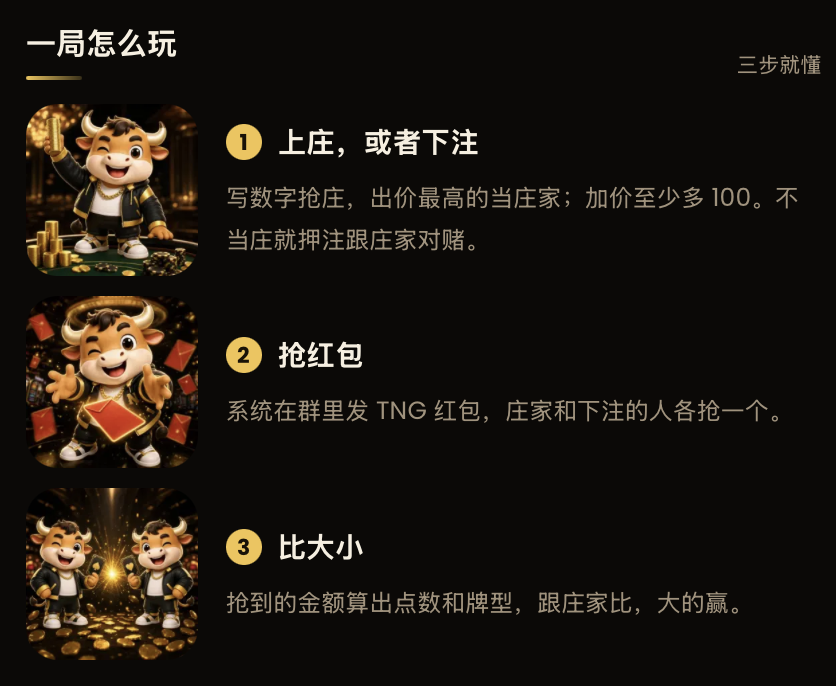
The process of a 68 NiuNiu round mainly consists of "bid for dealer or place a bet", "grab the red envelope", and "compare". At the start, the dealer and the betting players are decided first; the system then sends a TNG red envelope in the group, and the dealer and the betting players each grab one. The red envelope amount grabbed is used to calculate the round's points and card type, which are then compared against the dealer's to decide the result.
Step 1: Bid for dealer or place a bet
At the start of a round, players can choose to join the bidding to become dealer, or place a bet as a player. The dealer and player roles differ, but both move on to the red envelope grabbing and comparison stages that follow.
Step 2: Grab the red envelope
The dealer and the players who have placed bets need to grab the TNG red envelope sent by the system in the group; every dealer and betting player taking part in the round grabs one, which is used to calculate the round's result afterwards.
Step 3: Compare
Once the red envelopes are grabbed, points and card type are calculated from the amount grabbed, and compared against the dealer's result. The side with the greater result wins.
Step 1: Bid for dealer or place a bet
The first step in a round is deciding whether to take part as dealer or player. Players who want to become dealer need to bid for the position with numbers; players who are not bidding for dealer can choose to place a bet and wager against the round's dealer.
Want to be dealer: bid for the position with numbers
To bid for dealer, write a number to join the bidding. The page states "whoever bids the highest becomes dealer", so the round's dealer is decided by the bidding result.
Each dealer bid must raise by at least 100
When bidding for dealer, each raise must increase by at least 100. Users can enter a number based on the current bidding situation, and whoever bids highest ultimately becomes the round's dealer.
Not bidding for dealer: choose to place a bet
Players who do not join the dealer bidding, or who did not become dealer, can take part in the round as a player by placing a bet. After betting, the player wagers against the dealer and moves on to the red envelope stage that follows.
Step 2: Grab the TNG red envelope
Once the dealer and the players who have finished betting are confirmed, the round enters the red envelope grabbing stage. The system sends a TNG red envelope in the group, and the round's dealer and the players who have placed bets each grab one; the amount grabbed is used for the next step of calculating points and card type.
The system sends the TNG red envelope in the group
The red envelope is sent by the system within the group. Users taking part in the round should watch for the red envelope to appear and grab it following the round's process.
The dealer and betting players each grab one
Whether your role in the round is dealer or a player who has placed a bet, you each need to grab one TNG red envelope. The red envelope result is an important basis for the comparison that follows.
The red envelope amount is used to calculate the result
After grabbing the red envelope, the result is not simply a comparison of the total red envelope amount — the corresponding points and card type are calculated further from the amount, before entering the final comparison stage.
Step 3: Calculate points and card type to compare
Once the red envelopes are grabbed, the system calculates points and card type from the amount each person grabbed. The player's result is compared against the dealer's result, and the side with the greater result wins the round — so understanding points and card type is an important part of understanding how 68 NiuNiu is played.
Points are calculated from the red envelope amount
The red envelope amount each participating player grabs produces a corresponding points result. Points are one of the things judged when comparing.
Card type is identified from the red envelope result
Besides points, the red envelope result also forms a corresponding card type. The actual comparison needs to be judged together with the platform's card type rules, not just by how high or low the red envelope amount is.
Players are compared against the dealer
Each player who has placed a bet compares their result against the round's dealer individually. The outcome is judged from both sides' points and card type, and the side with the greater result wins that comparison.
The difference between dealer and player in a round
The dealer and player take part differently at the start of a round. The dealer is decided through number bidding, while the player takes part by betting; once the red envelope stage begins, both roles need to grab the TNG red envelope sent by the system, and the comparison is based on the points and card type formed from it.
The dealer is decided through bidding
Players who want to be dealer join the number bidding, each raise at least 100, and whoever bids highest becomes the round's dealer.
Players take part by betting
Players do not need to join the dealer bidding; instead, they choose to place a bet and wager against the dealer already decided for the round.
Both sides need to grab a red envelope
Once the red envelope stage begins, both the dealer and the players who have placed bets each need to grab one TNG red envelope sent by the system, and then the final comparison is completed based on the corresponding points and card type.
68 NiuNiu Round gameplay FAQ
68 NiuNiu How many main steps are there in a round?
A round mainly has three steps: first bid for dealer or place a bet, then grab the TNG red envelope sent by the system, and finally calculate points and card type from the red envelope amount, and compare against the dealer.
68 NiuNiu How do you bid for dealer?
To become dealer, join the bidding by writing a number; each raise must be at least 100, and whoever ends up bidding highest becomes the round's dealer.
How can you play without being dealer?
If you are not dealer, you can choose to place a bet and wager against the dealer as a player. After betting, you still take part in the round's red envelope grabbing and comparison process.
Who sends the red envelope?
According to the current gameplay description, the TNG red envelope is sent by the system in the group, and the dealer and players who have placed bets each grab one.
Is it just a direct comparison of red envelope amounts?
No. The red envelope amount grabbed is used to calculate points and card type, and the comparison is then made from both sides' results — so win or loss cannot be judged directly just from the total red envelope amount.
Do players compare against other players?
The current gameplay description shows that after grabbing the red envelope, you need to "compare against the dealer" — so betting players mainly compare points and card type against the round's dealer.
Learn 68 NiuNiu's complete round gameplay
Starting from bidding for dealer or placing a bet, learn the three steps of grabbing the TNG red envelope and comparing points and card type, and master the basic process of a round from start to result.